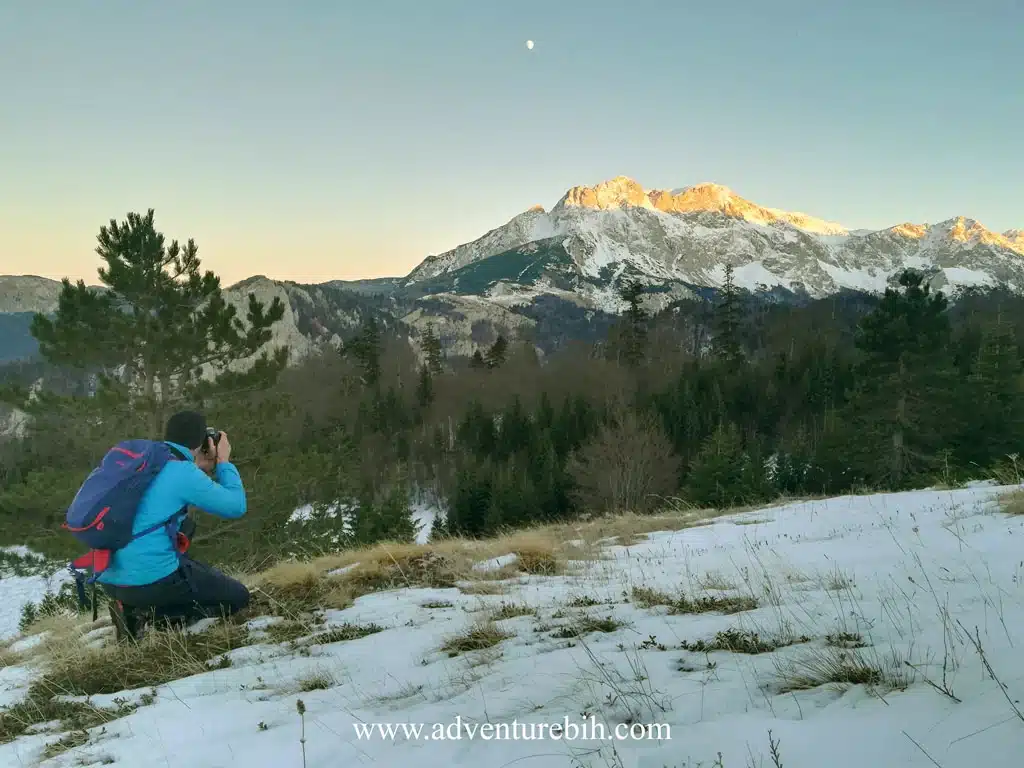

If you’re used to hiking in the Alps, Bosnia and Herzegovina will feel different from the first step. There are no cable cars, no busy mountain huts every few kilometres and rarely any summit queues. On many trails, especially outside July and August, you can walk for hours without seeing another group.
Here are some of the most rewarding hiking areas in the country — from high summits to wide alpine plateaus.
At 2,386 metres, Maglić is the highest peak in Bosnia and Herzegovina. Most hikers start from Prijevor, inside Sutjeska National Park. The trail begins gently, crossing open grassy slopes before turning steeper and rockier.
The final section includes exposed terrain and short secured cable parts along the ridge. It’s not technical climbing, but you need steady footing and good weather. When the sky is clear, the view stretches deep into Montenegro, and Trnovačko Lake lies below in a near-perfect heart shape.
It’s a long day on the mountain. Start early, carry enough water (min 2l) and don’t underestimate the wind on the summit ridge.
Best for: fit hikers who want a proper summit experience.
Zelengora feels completely different from Maglić. Instead of sharp ridges, you get rolling highlands, wide views and scattered glacial lakes.
Orlovačko and Štirinsko Lake are the most visited, but the real charm of Zelengora is the space. The trails are moderate, the terrain is open and you can easily design a two- or three-day trek connecting lakes and viewpoints. In late summer, the grass turns golden and the landscape feels almost endless.
It’s one of the best areas in the country if you prefer distance and scenery over steep ascents.
Best for: long, scenic hikes and multi-day trekking.
Prenj has a reputation among local hikers. The limestone peaks rise sharply, and the terrain is steeper and more demanding than in most other Bosnian mountain ranges.
Routes here require good navigation skills and strong physical condition. Weather changes quickly, and some sections are exposed. This is not the place for casual walking shoes or poor planning.
But if you’re comfortable in alpine terrain, Prenj offers some of the most dramatic mountain scenery in the country.
Best for: experienced hikers who enjoy technical terrain.
South of Sarajevo, Visočica is often overlooked by international visitors but well known among locals. The landscape mixes rocky ridges, wide plateaus and traditional shepherd shelters scattered across the mountain.
It’s less aggressive than Prenj but still wild enough to feel remote. You won’t find many facilities here, so bring what you need. On clear days, the views toward Bjelašnica and Prenj are wide and uninterrupted.
If you want a full day in the mountains without heavy crowds, Visočica is a solid choice.
Best for: moderate hikers looking for quiet routes near Sarajevo.
While not a classic hiking trail, Via Ferrata “Sokolov put” above the Mokro village adds a different dimension to a hiking trip.
Located between Sokolac and Pale, this protected climbing route follows exposed rock faces with steel cables and ladders. It’s suitable for beginners with proper equipment and guidance. The views over the village and surrounding hills are wide and surprisingly dramatic for a location so close to the city.
It’s a good option if you want to combine hiking with something more vertical.
Best for: hikers who want a controlled but exposed experience.
The main hiking season runs from late May to October. June and September are often the most comfortable months — stable weather, fewer visitors and moderate temperatures.
In early summer, snow can still remain on higher peaks like Maglić. July and August are generally stable but can be hot at lower elevations.
Always check local forecasts. Mountain weather here changes faster than many visitors expect.
Bosnia’s mountains are not heavily commercialised. You won’t find lifts or crowded infrastructure in most areas. Trails are marked, but you are responsible for your own planning.
That’s part of the experience. Hiking here feels closer to real mountain travel — quieter, simpler and less controlled.
Bosnia and Herzegovina may not be on every hiking map yet, but the terrain speaks for itself. From the exposed ridge of Maglić to the open landscapes of Zelengora and the sharp limestone peaks of Prenj, the country offers serious mountain experiences without the pressure of mass tourism.
If you’re looking for space, variety and a bit more raw character, this is a place worth walking.