Canyoning sounds extreme when you first hear the word. People imagine huge waterfalls and dangerous jumps. In reality, most canyoning routes are structured and guided — but they are still very real mountain terrain.
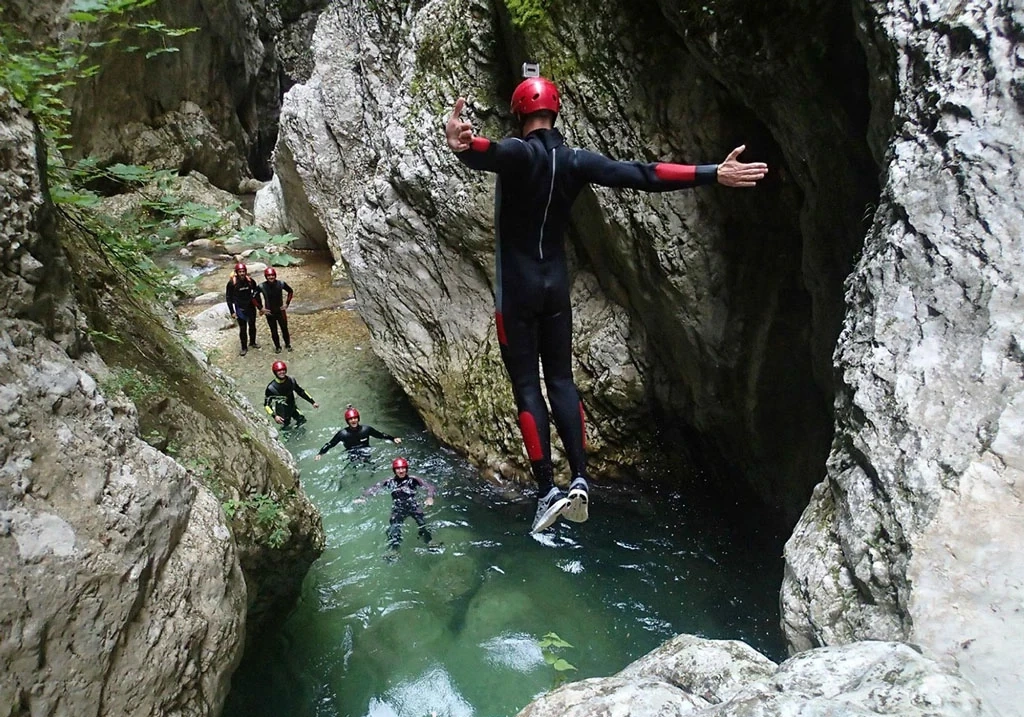
At its simplest, canyoning means moving downstream through a canyon. You don’t walk around obstacles. You go through them. That might mean wading through cold water, lowering yourself down a small waterfall on a rope, or sliding over smooth rock into a pool below.
You’re not just hiking beside nature — you’re inside it.
Every canyon is different, but a typical day usually includes:
Walking through shallow streams and rocky sections
Short climbs over boulders
Sliding down natural rock chutes
Optional jumps into deep pools
Controlled rope descents next to waterfalls
Some sections are calm and quiet. Others require focus and teamwork. You move slowly, one obstacle at a time.
You don’t need climbing experience. You don’t need extreme fitness. But you should be comfortable in water and prepared to be active for several hours.
It’s an honest question — and the right one to ask.
Canyoning involves water, rock and height, so yes, there is risk. The difference is in how it’s managed.
On a properly guided trip you will have:
A trained guide who knows the canyon
Helmet, wetsuit and harness
Clear instructions before each rope section
Decisions adapted to water levels and weather
No serious operator enters a canyon without checking conditions first. Sudden storms or high water can change everything. That’s why local knowledge matters.
Canyoning suits people who enjoy active outdoor experiences and don’t mind stepping outside their comfort zone a little.
It works well for:
Small groups of friends
Couples
Families with older teenagers
Travellers who want something more dynamic than hiking
It’s usually not a good fit for very young children, people with serious mobility issues, or anyone extremely uncomfortable with heights or cold water.
Difficulty depends entirely on the canyon. Some are gentle and beginner-friendly. Others are technical and physically demanding.
Expect cold water — even in summer. Mountain streams don’t warm up much.
Expect slippery rocks and moments where you need to trust your footing.
Expect to be moving almost constantly for three to five hours.
But also expect that strange quiet you only find inside narrow rock walls, where the sound of water echoes and the outside world disappears.
On a hiking trail, someone has marked the route for you.
In a canyon, the water has created the route. You adapt to the terrain as it comes — one pool, one descent, one narrow passage at a time.
There’s no straight line. That unpredictability is part of the appeal.
You’ll find canyoning in the Alps, Spain, Slovenia and parts of the UK. It’s also growing across the Balkans, where many canyons remain less developed and less crowded. In some parts of the region, you can experience guided canyoning in remote, untouched canyons rather than heavily commercialised routes.
In some regions, you might share the route with several other groups. In others, you might not see anyone else all day.
If you enjoy being active and want something more immersive than a standard hike, canyoning is worth trying at least once.
It’s physical without being competitive. It’s adventurous without requiring months of training. And it gives access to places most people only see from above.
Canyoning isn’t about chasing adrenaline for its own sake. It’s about moving through landscapes shaped by water over thousands of years.
Done properly, with the right guide and conditions, it’s not chaos — it’s controlled exploration.
And once you’ve walked through a narrow canyon with water running past your boots and sunlight cutting through the rock walls above, normal trails feel a little different.